Stripe payments without surprises: idempotent webhooks in Bun + Elysia
Why I confirm payments in the webhook and not on the redirect, how to verify the signature in Elysia, and how to avoid duplicate tickets.
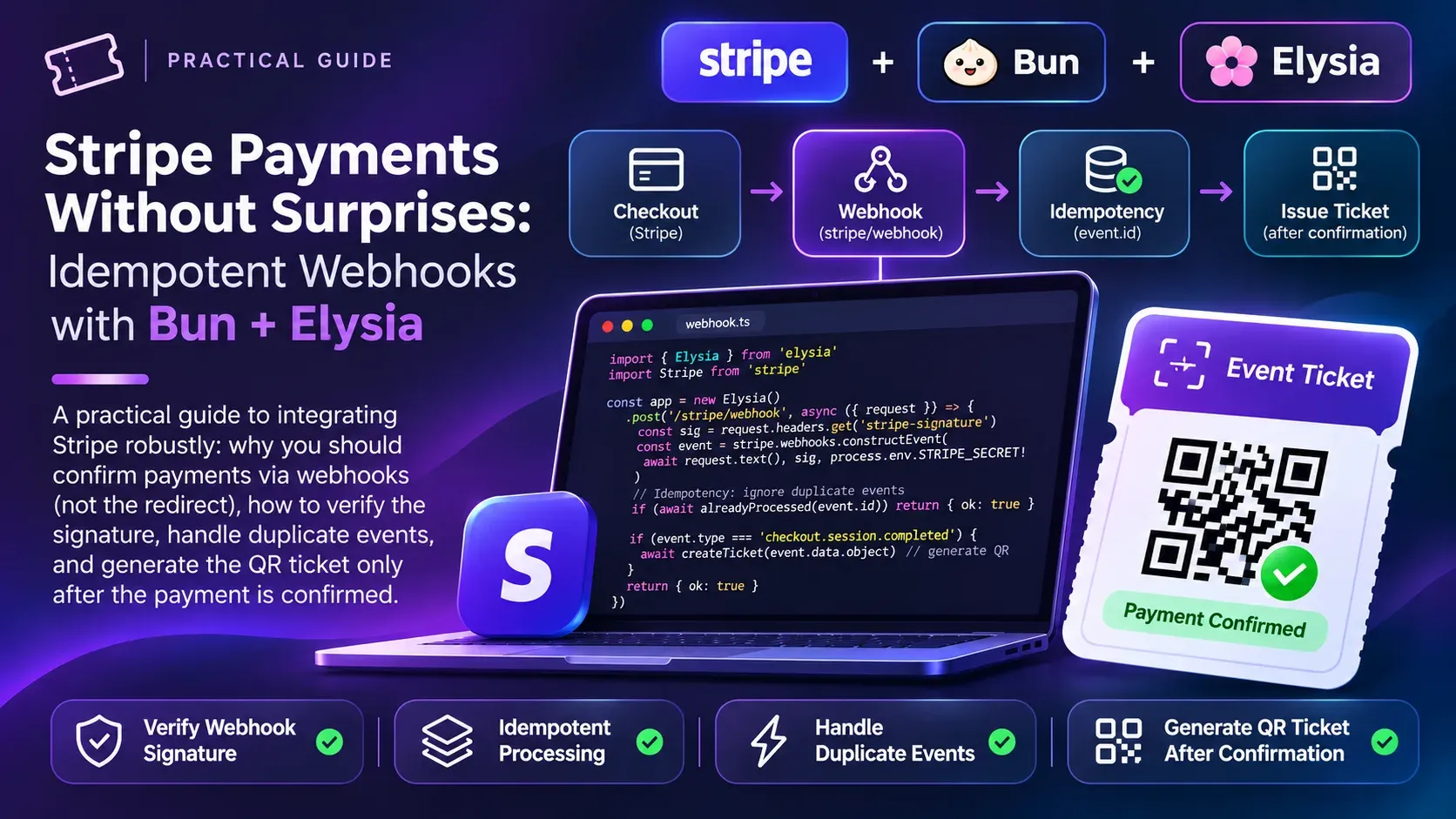
In my Event Ticket System, users buy tickets with Stripe and receive a ticket with a QR code. Integrating payments is easy; doing it without surprises takes a few details.
Don’t trust the redirect
With Stripe Checkout, when the payment finishes the user returns to your success_url. It is tempting to create the ticket there, but:
- The user may close the tab before coming back.
- Anyone can open
/payment/successby hand. - Some payment methods are confirmed minutes later.
The source of truth is the webhook: Stripe calls your server when the payment is confirmed. The success page only shows a message.
The flow
- The user asks to buy. I check that the event is published, that there is capacity, and that they don’t already have a ticket.
- I create the Checkout Session with the
eventIdanduserIdinmetadata, set to expire in 30 minutes. - Stripe sends
checkout.session.completedto the webhook. - I verify the signature, check
payment_status === "paid", and create the ticket with its QR.
Verifying the signature in Elysia
Stripe signs every webhook. To verify it you need the exact, unparsed body. Elysia parses JSON automatically, so I capture the raw body in onRequest, before the parser runs:
export const webhookRoutes = new Elysia({ prefix: '/webhooks' })
  .onRequest(async ({ request }) => {
    const url = new URL(request.url);
    if (url.pathname === '/webhooks/stripe' && request.method === 'POST') {
      (request as any).rawBody = await request.text();
    }
  })
  .post('/stripe', handleStripeWebhook);
And in the handler:
const signature = headers['stripe-signature'];
const rawBody = (request as any).rawBody;

let event: Stripe.Event;
try {
  event = stripe.webhooks.constructEvent(rawBody, signature, STRIPE_WEBHOOK_SECRET);
} catch {
  set.status = 400;
  return { error: 'Invalid webhook signature' };
}
This endpoint has no JWT: the signature is the authentication. Without it, anyone could send a fake “payment completed”.
Idempotency: the same event can arrive twice
Stripe retries a webhook if it doesn’t get a 2xx, and it may deliver an event more than once. If your handler creates a ticket every time, you end up giving tickets away.
My rule: one payment = one ticket. Before creating the ticket, I check whether one already exists for that payment_intent:
const [existing] = await db
  .select()
  .from(tickets)
  .where(eq(tickets.paymentId, paymentId))
  .limit(1);

if (existing) return existing; // already processed, do nothing
Since I also listen to checkout.session.async_payment_succeeded (payments confirmed later), the same payment could arrive through two different events. Using the payment_intent as the key covers both cases.
One extra tip: back this rule up in the database with a UNIQUE index on payment_id, and treat the duplicate error as “already processed”. That way, even if two webhooks arrive at the same time, the database guarantees there won’t be two tickets.
The QR, only once the payment is confirmed
The ticket is generated inside the webhook, never before. Before creating it I check capacity again, in case the event filled up while the user was paying. Then I generate a unique code and its QR:
const ticketCode = await this.generateUniqueTicketCode();
const qrCode = await QRCode.toDataURL(ticketCode, { errorCorrectionLevel: 'M', width: 300 });
At the door, staff scan the QR and the ticket is marked as used.
What to reply to Stripe?
Stripe expects a fast 2xx; if it doesn’t get one, it retries. So it’s best to reply quickly and log any processing error. And because the handler is idempotent, a retry never creates a duplicate ticket.
Testing locally
stripe listen --forward-to localhost:3000/webhooks/stripe
stripe trigger checkout.session.completed
The CLI gives you the whsec_... for your .env. That way you can test the whole flow without deploying.
Conclusion
Webhook as the source of truth, verified signature and idempotency by payment_intent. With those three rules, payments stop surprising you.