Secure sessions in a SPA: httpOnly cookies + CSRF with FastAPI and React
Why I do not store the JWT in localStorage, how I configure session cookies, and how I implemented CSRF protection with the double-submit pattern in MediCore.
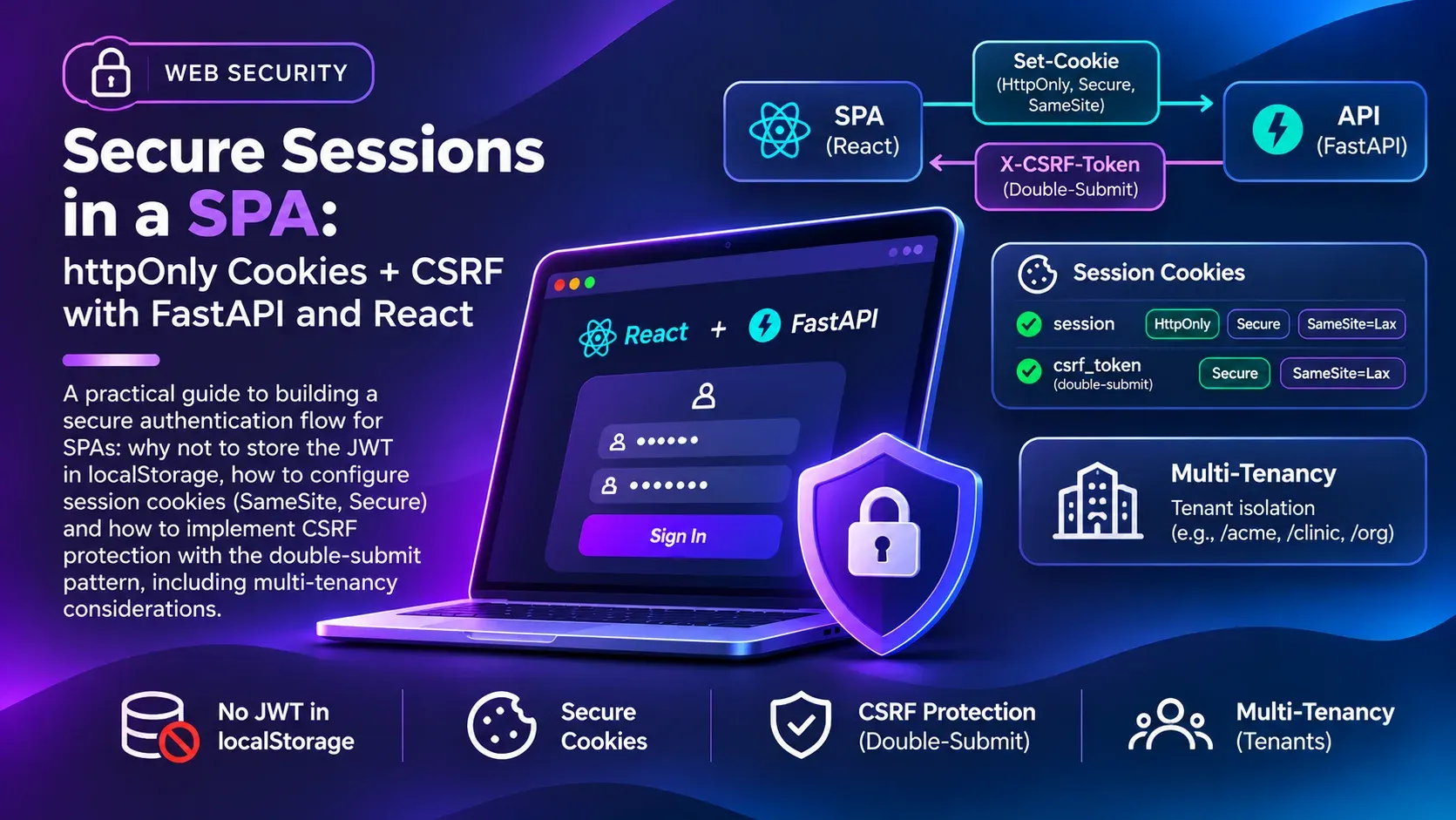
In MediCore, a clinic management system, we handle medical records. Session security there is not negotiable. This is the approach I used and why.
The problem with localStorage
The typical JWT tutorial says: log in, store the token in localStorage and send it in the Authorization header. It works, but any script running on your page can read localStorage. A single XSS (a compromised dependency, badly escaped HTML) and the attacker walks away with the token.
httpOnly cookies
The alternative is for the backend to store the token in an httpOnly cookie. The browser sends it automatically on every request and JavaScript cannot read it.
In FastAPI:
response.set_cookie(
    "session",
    token,
    max_age=max_age,
    httponly=True,   # invisible to JavaScript
    samesite="lax",  # not sent on cross-site POSTs
    secure=is_production,  # HTTPS only in production
    path="/",
)
On the frontend you only need to tell Axios to send cookies:
export const api = axios.create({
  baseURL: '/api/v1',
  withCredentials: true,
});
But now you have CSRF
Because the browser sends the cookie automatically, another site could trigger a request to your API using the user’s session. That is CSRF. SameSite=Lax already blocks most cases, but I prefer a second layer.
Double-submit cookie
The idea: on login, the backend sets a second cookie, this one readable from JavaScript, with a random value. On every request that changes data, the frontend copies that value into a header. An external site cannot read your cookies, so it cannot set the right header.
On login:
response.set_cookie(
    "csrf_token",
    secrets.token_urlsafe(32),  # new on every login
    max_age=max_age,
    httponly=False,  # the SPA needs to read it
    samesite="lax",
    secure=is_production,
)
On the frontend, an Axios interceptor:
const SAFE_METHODS = new Set(['get', 'head', 'options']);

api.interceptors.request.use((config) => {
  if (!SAFE_METHODS.has((config.method ?? 'get').toLowerCase())) {
    const csrf = readCookie('csrf_token');
    if (csrf) config.headers['X-CSRF-Token'] = csrf;
  }
  return config;
});
And on the backend, the dependency that resolves the session checks that they match:
if is_mutating(request.method):
    csrf_cookie = request.cookies.get("csrf_token", "")
    csrf_header = request.headers.get("X-CSRF-Token", "")
    if not csrf_cookie or not secrets.compare_digest(csrf_cookie, csrf_header):
        raise ApiError(403, "CSRF token missing or invalid")
I use secrets.compare_digest instead of == so the comparison takes the same time no matter how many characters match.
Details that add up
- Server-side sessions. The JWT carries a
sidthat points to a session stored in the database. That lets me end sessions remotely: users see their active devices and an admin can revoke them. A plain JWT cannot be invalidated before it expires. - Separate sessions per console. The platform admin console uses its own session, independent from each clinic’s.
- CSRF token rotation. A new one is generated on every login, so an old value is useless for a new session.
- 401 → logout. A response interceptor clears the state when the cookie expires, and the router sends the user to the login page.
Conclusion
httpOnly cookies + double-submit are no harder than a JWT in localStorage, and they remove the most common SPA problem. If your app handles sensitive data, it is worth doing from day one.